Place
Level REDACTED
Warning: This file is not authorized under a registered M.E.G Database account. If you'd like to access this file, please log your visit by signing in with the following kiosk. Error Code: 622
"The Downrooms"
“That is not dead which can eternal lie, And with strange aeons even death may die.” — Howard Phillips Lovecraft
Level ███████, sometimes called 'The Downrooms' or God's Blind Spot, appears as a self-contained maze of endless, layered spaces. Its nature is defined by quiet repetition, muted senses, and a subtle distortion that lingers in the mind.
Level ███████ does not reveal itself in the way most Backrooms levels do. There is no sense of threat, no tension in the air, and nothing unusual to catch the eye. For those who know the Backrooms, this quiet absence can be unsettling on its own. Most levels feel like places, with their own patterns, dangers, and limits. Even the most chaotic spaces still offer something to explore or understand.
Level ███████ is different. It feels less like a place and more like a state you drift into and remain within. At first, everything seems familiar, as if designed to put you at ease. The spaces resemble ordinary communal areas: corridors, lobbies, playrooms, basements, dining halls, stairwells, fenced yards, roadways, and lounges. Nothing is exaggerated or out of place. Each area is clean, functional, and quietly welcoming. The lighting is gentle and unchanging, the walls and floors are intact, and there is no hint of physical danger. Moving through these spaces feels effortless. This is where the difference becomes clear. In most Backrooms levels, you search for something—an exit, supplies, boundaries, or even just a reason. Here, movement is all there is, and it never leads anywhere. Every room and hallway is part of an endless maze, whether inside or outside, open or closed, rising or flat. Corridors branch without end, rooms repeat, and every path stretches on, always leading to another space just like the last.
This level does not unsettle through chaos or threat. Instead, it unsettles through sameness. Sub-levels shift without warning, but the changes are gentle, never jarring. A hotel corridor might become a playroom, or a fenced yard might fade into a basement lounge, with no clear line between them. These transitions feel natural, as if each space is meant to flow into the next. Over time, the differences between areas blur and fade, since every part follows the same endless pattern. What truly sets this level apart is how it quietly shapes those who wander inside. Most Backrooms levels are indifferent, existing whether anyone is there or not.
This level feels quietly attentive. Not in any obvious way, but enough that, after a while, you find yourself changed. Stillness becomes uncomfortable. Pausing feels wrong. Movement becomes instinctive, even when there is nowhere to go. The environment quietly insists that you keep moving.
Section I. Overview
Level Overview
Level ███████ appears as a maze made up of countless sublevels, each one blending into the next. The spaces look different at first, but they all follow the same pattern: endless branching paths, no visible exits, and a layout that resists being mapped. There are no clear boundaries or starting points. Sublevels shift into each other without warning, sometimes through doorways or corridors, and sometimes with no sign at all. Moving from one area to another feels smooth and unbroken, as if the entire level is a single place that keeps changing its shape.
Structure and Layout
Each sublevel of Level ███████ stretches out as an endless maze, its spaces branching gently into corridors, rooms, stairwells, and open halls that echo one another with only the smallest changes. Loops are almost never found. Instead, the maze relies on repetition and sheer scale to dissolve any sense of progress, so that moving forward feels real but never brings change. At first, the layout feels simple enough to follow. Corridors are wide and easy to walk. Paths are open, intersections offer choices that seem harmless. Over time, though, the lack of landmarks and the sameness of every space make it impossible to stay oriented. Places begin to feel familiar without ever being truly known. Moving through the maze becomes automatic, a quiet routine rather than a plan. Stairs, ramps, and split levels appear often, but going up or down never means reaching anything new. Both directions only serve to stretch the journey further, with no destination in sight.
Characteristics
Level ███████ remains stable at all times. There is no sign of collapse, decay, or environmental danger. Each sub-level keeps a steady temperature, and the air is still or barely moving. Water, if it appears, is always perfectly level and undisturbed. Lighting never flickers or fails. The environment seems to care for itself, untouched by outside forces. Sound is quiet and controlled. In carpeted or furnished spaces, noise is absorbed until it nearly disappears. In larger, open areas, footsteps echo softly before fading away. Sound does not travel far, and echoes often seem to come from no clear direction. Silence is common, but never absolute. The space feels subdued, never empty. Time is difficult to sense. There are rarely clocks, windows, or any sign of changing light. Long stretches of walking do not bring exhaustion beyond what is immediately felt. Hunger, tiredness, and discomfort are softened or delayed, as if Level ███████ exists outside the usual flow of time.
Section II. Anomalies
While Level ███████ seems structurally stable and mostly safe, spending more time there reveals many recurring anomalies. These phenomena do not pose immediate dangers, but they also lack enough consistency to be easily categorised. On their own, they seem harmless or incidental. Together, they suggest an underlying influence that remains unseen but can be inferred from its effects.
Spatial Irregularities
The most common anomaly here is a gentle shifting of space. Corridors and rooms appear unchanged at first, but their positions drift quietly over time. A turn that once led to a familiar place may now open into a room that is almost the same, yet not quite. Distances stretch or contract without warning. Spaces that should be close together feel distant, while far-off rooms can be reached in only a few steps. The changes are never sudden. They unfold slowly, always out of sight. Marking a wall or measuring a hallway offers no certainty, as nothing remains fixed for long. The level preserves a sense of seamless movement, but any attempt to track progress fades away.
Objects and furniture appear again and again, scattered through the level in patterns that almost repeat. A chair sits where it should, but its cushion is a different shade. Murals return with colours that shift just enough to notice. Words painted on the walls remain unchanged, yet their placement drifts from one room to the next. These small differences are easy to miss at first, but they linger, quietly unsettling memory. After a while, it becomes difficult to tell if a space has been seen before or if it only feels familiar. The level does not confuse through disorder, but by offering a comfort that is never quite complete.
Environmental Distortions
There are signs that the environment responds to presence, though never directly. In some places, the light seems to linger just a little longer, as if waiting. Corridors may gently widen or narrow depending on the pace of your steps. Outdoor paths sometimes appear brighter when you move forward without pause, while stopping or turning back causes the light to fade. These shifts are quiet and easily overlooked, and nothing ever confirms that they are deliberate. Still, many describe a sense that movement is quietly encouraged, while standing still feels quietly discouraged. The level never forbids rest, but it shapes itself so that moving forward always feels like the natural thing to do.
Sound drifts and changes throughout Level ███████. In some rooms, footsteps are swallowed by the floor, leaving only silence. Elsewhere, echoes return softly from places that cannot be seen. At times, the sound of movement lags behind, arriving a moment late. Occasionally, footsteps continue for a few seconds after stopping, fading into the quiet. These moments are brief and often brushed aside as tiredness or imagination. They never last long enough to be studied, but they return often enough to be remembered. No other sounds ever seem to come from anywhere else.
Section III. Entrances and Exits
Entrances
I have no memory of entering this level at all. I do not remember any transition, as if it never happened. No doorway or stairwell marks the beginning. There is no transition, only the quiet realization of already being here. The environment does not shift or announce itself. There is no shock, only a gentle awareness that something is wrong, that this place is not where I am meant to be. Attempts to retrace my path lead only to repetition. Walking in every direction returns the same rooms and corridors, each one blending into the next. There are no seams or boundaries, nothing to suggest an outside connection. Every path simply leads further in, as if the level has no edge at all.
Exits
No exits have appeared. Every attempt to find a way out has failed. Locked doors, broken walls, unstable sections, or any sign of passage elsewhere are simply absent. The level remains unchanged, offering no fractures or weaknesses. Its structure is unbroken, and nothing shifts or gives way. The environment gives no indication that it was ever meant to connect to anything beyond itself. There are no unfinished edges, no boundaries, and nothing that suggests a transition point. The level feels entirely self-contained, as if isolation is its only purpose. There is no way to prove that exits are impossible. Still, after searching, it seems likely that if any exits exist, they are not meant to be found from within.
Section IV. Sub Levels
A list of sublevels of Level ███████ follows. It should be noted that all information given below was reported by a single source, Dr. Julian Charles. While the following sublevels may appear for all wanderers, it is also possible that each wanderer encounters a different set of sublevels.
Sublevel 0
Entry 1
Sublevel 0
Sublevel 0 spreads out as a large maze of concrete corridors, all painted an intense orange that fills the space. The shade is uneven and layered, shifting subtly from deep amber to rusty red and pale, tired yellow. In some spots, it looks thick and heavy, as if it has soaked into the concrete over a long time. In other areas, it appears faded and fragile, like something left too long under harsh light. The concrete walls are rough and raw, marked with numerous imperfections. Small cavities are scattered throughout the structure, while long cracks run along the corridors, branching and rejoining in patterns that seem oddly intentional. Wide scrape marks stretch across the walls at about shoulder height, worn smooth compared to the surrounding roughness.
The material gives off a gentle warmth, neither comforting nor oppressive, just there, as if the maze has been holding heat since it was built. A thick, permanent fog fills the corridors from floor to ceiling. It is dark and heavy, dulling contrasts and softening the edges of everything it touches. Visibility fades quickly, causing hallways to dissolve into unclear shapes just a short distance ahead. Corners and intersections slowly appear from the haze, revealing themselves bit by bit as you move. Distant corridors sometimes look like faint silhouettes, blurred and distorted, never completely clear. There is no clear source of light (Besides the occasional light bulb). Instead, the walls themselves emit a soft, diffused glow that seeps into the fog, providing just enough illumination to move around.
The brightness is even and steady, creating a flat, depthless feel that makes judging distance hard. Shadows cling tightly to edges and seams, never becoming deep or sharp, but also never disappearing. The air in the maze is still and heavy, carrying a faint mineral smell. Sounds are muted, softened by the fog and absorbed by the concrete. Footsteps create a soft echo that fades quickly, leaving behind a quiet that feels vast rather than empty.
The environment stays the same no matter how far you go, offering no landmarks or changes to suggest progress or direction. Corridors curve at gentle angles, sometimes opening into wider areas before narrowing again. The repeating forms and colours create a sense of continuity that blends individual spaces together. Over time, the maze feels less like a collection of paths and more like a single, continuous structure, folding in on itself with no clear beginning or end. Everything in the sublevel seems complete in its sameness. The orange walls, the dark fog, and the uniform light come together to create a space defined entirely by texture, colour, and scale. It is a space that neither guides nor blocks, but exists, stretching endlessly in every direction with quiet, steady persistence.
Perhaps not knowing what lies behind the fog is a blessing.
Sublevel 1
Entry 2
Sublevel 1
Sublevel 1 is a maze of interconnected living rooms with no clear layout. Each room looks like a living area from an indistinct mid-20th-century time. The furniture seems mass-produced: low-backed fabric sofas, boxy armchairs, rectangular coffee tables, standing lamps with off-white shades, and wooden cabinets with empty shelves. Every piece shows moderate wear. Cushions are compressed, upholstery along the armrests is worn, and table surfaces are scratched from years of use. The entire area is in muted greys. The walls have faded wallpaper with repeated floral or geometric patterns that have lost contrast. The carpets are thick and dusty, with fibres matted down from long-term use. Curtains hang over windows looking into other rooms, creating an illusion of depth without revealing anything beyond the maze. Glass reflects poorly, distorting images that do not match the room's current arrangement. The lighting is even and diffuse. No lamps are plugged in, but all rooms are well-lit, as if by an external source filtered through heavy clouds. Shadows are soft and barely visible, never forming completely under furniture.
The air is still and smells of old fabric, dust, and a hint of mildew. The temperature stays constant, neither warm nor cold, creating an uncomfortable sense of neutrality over time. Moving through the sublevel is quiet, but not silent. Footsteps sink into the carpet, making dull sounds that do not carry far. Occasionally, isolated noises emerge without a clear source: a subtle creak from a sofa cushion, a faint scrape of wood on carpet, or the gentle click of a lamp switch that does not change the lighting. Clocks are found in many rooms, mounted on walls or sitting on tables, but none of them work. Their hands are stuck at different times, suggesting stopped moments rather than broken clocks. Room connections are inconsistent. Doorways lead into spaces that closely resemble those already passed through, but they are never exact duplicates.
The furniture arrangement shifts slightly from one room to the next. A chair might be turned a little, a table moved closer to a wall, or a lamp shifted to another corner. Hallways can narrow or widen unexpectedly, and some doorframes lead directly into similar rooms rather than through transitional spaces. More extended travel reveals a pattern of spatial adjustment. Rooms visited earlier do not appear in the exact locations. Paths behind the subject tend to change subtly, while paths forward remain clear, creating a direction that discourages going back. Despite the homey feel of the environment, no room provides absolute comfort. Sitting for long periods creates pressure and restlessness, as if the space is meant for brief use only.
The sublevel gives a constant impression of being watched due to its layout and consistency. The repetition of rooms, the lack of usable exits, and uniform lighting create a feeling of continuous observation, as if an unseen gaze monitors intruders. The environment does not react overtly, but its control over space, sound, and visibility suggests careful design rather than mere decay. Nothing in the sublevel changes meaningfully. The rooms do not further deteriorate or reset. They remain in a permanent state of use without users, forming a never-ending domestic structure that feels familiar but serves no purpose.
Everything in Sublevel 1 seems to exist in a state of waiting. Waiting for something to arrive, I don't know what.
Sublevel 2
Entry 3
Sublevel 2
Sublevel 2 looks like a house that was never meant for long stays. The area is enclosed and low, with slanted ceilings that push inward, narrowing the room and subtly distorting its proportions. At first glance, the architecture feels homey, but something about it resists comfort. It seems to mimic familiarity rather than truly embody it. Every surface is covered in the same worn floral wallpaper. The pattern repeats endlessly, with small clusters of faded flowers arranged cheerfully, their colours dulled over time into yellowed cream, dusty green, and pale pink. The wallpaper flows uninterrupted across walls, doors, columns, and even furniture shapes, erasing clear distinctions between objects and structure. Seams are hard to find, creating the impression that the room is wrapped rather than built.
The floor is bare and dark, soaking up the little light that comes through. It feels unfinished, as if something was supposed to be there but never was. Sound doesn’t carry well. Even small movements seem absorbed by the room, leaving behind a thick quiet that feels padded and closed off. The air is still and a bit stale, carrying the dry, papery smell of old interiors kept away for too long. A narrow staircase rises from the corner, with steep and uneven steps. The railing is thin and pale, blending into the wallpapered walls around it, as if being slowly consumed by the space. The stairs lead up into shadow, where the ceiling dips even lower, hinting at more rooms crammed into similar shapes. The opening at the top feels less like a passage and more like a continuation of the same room, folded vertically instead of outward.
Light comes in weakly, with no visible source. It spreads flatly across the walls, lighting the wallpaper without creating shadows. Corners fade together, making depth hard to judge. The room seems smaller the longer you look at it, as if the boundaries are subtly closing in or being reshaped by your attention. Nothing in the space appears damaged, yet nothing feels cared for. The wallpaper is intact but old, while the structure is stable but tired. The pattern's repetition begins to overwhelm perception, making the walls feel closer, and the room seem more crowded than its emptiness suggests. Overall, the impression is not one of danger, but of confinement through familiarity. The space feels frozen in a state of quiet stagnation, endlessly repeating its own domestic image. It offers shelter without comfort, structure without clarity, and the unsettling sense that this room is just one of many identical variations, stacked, folded, and connected out of sight.
This place reminds me of my cousin's house.
Sublevel 3
Entry 4
Sublevel 3
Sublevel 3 opens into a vast, uninterrupted space that looks like a large store stripped of its purpose. The ceiling reaches high above, covered in uniform tiles with rows of recessed fluorescent lights. Every light is on, casting a steady, colorless glow that fills the room evenly and leaves no corner in shadow. The light feels permanent, as if it has been shining far longer than needed and will never be turned off. Long aisles stretch across the floor. They are formed by tall, pale shelving units arranged with careful precision. The shelves are completely empty. Their surfaces are smooth and slightly scratched, showing subtle signs of past use but offering no clues about what was once there. Each unit stands rigid and evenly spaced, creating corridors that feel wide yet strangely constraining, as if the openness only highlights the emptiness within them. The floor is clean and flat, made of dull, light-colored material that reflects the overhead lights without any warmth. Footsteps echo softly and then fade, absorbed by the room’s size.
Sound does not carry far here; it disperses quickly, leaving a silence that feels hollow rather than simply quiet. Signs hang from the ceiling and are attached to the shelves. Some have numbers or faded labels that suggest categorisation. They no longer match anything significant. Aisles stretch forward and branch off, but every direction looks the same. Each path fades into identical rows of shelving and repeating lights. It is hard to judge distance, as the uniformity makes the space feel flat, causing far-away walls to seem both close and unreachable. The air is dry and stale, carrying a faint scent of dust and old plastic. There is no sign of airflow, yet the temperature stays unnaturally constant. The environment feels maintained but empty, preserved in a state of readiness that will never be fulfilled.
Toward the edges of the space, the shelving narrows and opens into wider areas before forming new aisles again. Walls, when they appear, are plain and bare, with no windows, doors, or reference points. The ceiling lights continue without interruption, receding into neat rows that enhance the illusion of endlessness. The longer one stays in the sublevel, the more the space feels less like a store and more like a framework. The shelves seem placed not to hold items, but to define movement. The lighting is there not to illuminate but to ensure nothing is hidden. Everything about the environment suggests it was designed to be filled, yet its emptiness feels intentional, as if removal rather than placement is its final state. This place is shaped entirely by a function that no longer exists, left behind in perfect order. The space does not invite exploration or rest. It simply goes on, aisle after aisle, light after light, maintaining its vast, vacant order without change or conclusion.
Nothing moves here except you.
Sublevel 4
Entry 5
Sublevel 4
Sublevel 4 consists of small living spaces caught in a moment that never ends. The rooms are simple and well-organised, with pale walls and low ceilings that give them a cozy, homey shape. Furniture is arranged thoughtfully: a small wooden table with basic chairs, a cushioned couch tucked into a corner, and framed pictures hung at careful heights. At first glance, everything seems ordinary, as if someone stepped out for a moment and never came back. Windows fill the walls, each one glowing with a deep, unnatural red light. The outside does not change or flicker. It presses through the glass, casting muted crimson tones that wash over the furniture and walls, dulling their original colours. Curtains hang partially drawn, thin and white, softening the glow without blocking it. The fabric catches the light unevenly, making the red look layered, as if it has depth rather than brightness. The windows reveal nothing beyond their color. There are no shapes, no movement, no sense of distance. The red remains constant, flat and opaque, like a surface rather than a horizon.
It feels like a sky held too close or a light source pressing directly against the glass. Standing near the windows does not clarify anything. The glow feels just as distant up close. The rooms are comfortably furnished but lack emotional warmth. The cushions on the couch show slight indentations, as if they’ve been used many times without settling further. The carpet is clean but worn smooth in subtle paths. The air is still, carrying a faint scent of fabric and old wood, the kind that lingers in rooms that have been closed for a long time. Light from the windows does not cast sharp shadows. Instead, it spreads evenly, flattening depth and blurring edges. Corners blend softly, and objects appear less solid the longer they are observed. The pictures on the walls show vague scenes, landscapes or structures that feel familiar without being identifiable. Their details never fully resolve, even upon close inspection. Despite the homely arrangement, the space lacks a sense of rest. Sitting feels temporary. Standing feels pointless. The room does not encourage movement, but remaining still feels incomplete.
The red glow outside never changes to signal time, keeping the interior in a prolonged, unmarked state. The overall feeling is one of quiet containment. The rooms neither threaten nor comfort. They exist, sealed between ordinary walls and extraordinary windows, holding the idea of a living space while slowly taking away its purpose. Everything stays in place, bathed in red light, waiting for something that never comes.
Perhaps it's best not to know what lies beyond the red mist.
Sublevel 5
Entry 6
Sublevel 5
Sublevel 5 is a narrow interior filled with small, adjoining rooms, all covered in faded floral wallpaper. The pattern is delicate and repetitive, with pale flowers and thin vines blending under dim, uneven lighting. The colours have faded into washed-out pinks and greys, giving the walls a tired, papery look, as if they have absorbed the same stale air for decades. The rooms connect through slightly misaligned doorways.
The doorframes are thick and boxy, painted white but yellowed with age, their edges softened by many layers of old paint. Doors hang ajar at odd angles, neither fully open nor fully closed, allowing glimpses into adjacent spaces. Each doorway frames another section of the same wallpapered area, creating a sense of repetition that makes it hard to tell where one room ends and the next begins. Windows are set back into the walls, partly obscured by thin curtains and bent blinds. The glass is dark, giving no clear view outside, only a vague, shadowy reflection of the interior. Below the windows sits a small built-in fixture, its purpose unclear, stained along the edges as if something once leaked or collected there over time. The area around it feels heavier and more enclosed, drawing attention without explanation.
The floor is bare and dark, soaking up light and sound. Footsteps make only a soft, muted noise, quickly absorbed by the close space. The air is stale and still, carrying a faint scent of old fabric and dust. The temperature is constant, neither cold nor warm, creating a feeling that the environment has settled into a permanent, unchanging state. Lighting is dim and indirect, with no visible source. Shadows gently gather in corners and along the ceiling, never deep enough to hide anything, but thick enough to soften outlines and blur depth. The ceiling feels low, even when it technically isn't, pressing down with subtle visual weight. Nothing in the sublevel seems damaged or broken. Everything is intact and functional, but lacking context. The repetition of rooms, doorways, and wallpaper creates a familiar cycle that disorients rather than reassures.
After spending time here, the space feels less like a series of rooms and more like a single area folded in on itself repeatedly. The sublevel offers no clear destination. Each doorway leads only to another version of a similar space, quietly reinforcing the idea that this area was never meant to be navigated, but to be occupied indefinitely, preserved in a state of quiet domestic stillness with no clear beginning or end. It keeps the idea of a living space while slowly stripping it of purpose. Everything remains in place, bathed in red light, waiting for something that never comes.
At least, I can only hope that it will never come.
Sublevel 6
Entry 7
Sublevel 6
Sublevel 6 is an endless interior maze of narrow corridors and small rooms that connect. They all have the same muted, domestic style. The walls are coated in lightly textured, off-white, uneven plaster. The light catches the walls in soft gradients, making the corners look rounded and unclear. Every surface feels intentionally simple, as if the space were designed to blend in while still completely enclosing everything. The floors are tiled with dull, reddish-brown squares worn smooth by countless footsteps. The tiles give off a faint reflection, creating shallow highlights that stretch and bend around corners. Each hallway connects to another at shallow angles, branching out frequently and unpredictably but never opening into anything really spacious.
Rooms appear briefly before disappearing back into the corridors, with their layouts subtly changing each time. Doorways break up the maze at random spots. Some lead to dark rooms with no visible features, while others open to corridors that somehow feel familiar even though they are newly entered. Often, doors are missing, leaving rectangular frames that seem to exist to suggest separation. When doors are present, they are usually ajar, revealing dense darkness rather than emptiness. Lighting is minimal and inconsistent. Soft light spills from unseen sources, forming triangular patches on walls and floors before it fades abruptly. Shadows stretch unnaturally across corners and linger longer than expected. As you move, the light shifts behind you without reason, as if the maze is changing focus rather than reacting to your presence. Throughout the space, there are random objects that feel out of place. A small wheeled toy leans against a wall. A rug lies folded or partially spread in a corner. These items appear undamaged, yet they seem untouched by time, sitting exactly where they were last left. Their presence gives a brief sense of familiarity that quickly fades, leaving the feeling that they don't fit into a larger picture. Sound is muted and irregular. Footsteps echo briefly, then disappear, sometimes returning from an unexpected direction. The air is still and slightly warm, carrying a scent of plaster and old flooring. No drafts move through the halls, and there are no distant noises suggesting an end or an outside world.
As the maze goes on, repetition becomes more noticeable. The same corner appears again, lit slightly differently. The same doorway feels closer than it should. Distances stretch and compress in subtle ways, making it impossible to gauge your progress. The layout doesn’t loop neatly but never truly advances, creating a feeling of constant movement without actually going anywhere. The sublevel offers no landmarks or sense of destination. Each corridor only leads to more of the same restrained interior, quietly reinforcing the idea that the maze is not meant to confuse or trap you through complexity, but through unending familiarity. It is a space defined not by what it holds, but by how thoroughly it eliminates the idea of somewhere else, extending endlessly in calm, unremarkable persistence.
For what it's worth, I'm practically dead.
Sublevel 7
Entry 8
Sublevel 7
Sublevel 7 unfolds like an endless maze of low-ceilinged rooms, all featuring the same outdated recreational décor. The environment is covered wall to wall in thick, patterned red carpet, with the repeating designs blending as the maze stretches on. The carpet muffles footsteps almost entirely. Movement feels distant and surreal, like walking through a memory instead of a physical place. The walls alternate between dark wood panelling and heavy, textured stone. The stone looks decorative, arranged in uneven slabs that form fireplaces and recessed alcoves. None of the fireplaces shows any signs of use. Their openings are dark and shallow, providing no warmth, no ash, and no depth beyond a thin layer of shadow. They repeat throughout the maze at irregular intervals, sometimes appearing at dead ends, sometimes lining long corridors in quiet succession. Structural columns frequently divide the space. They are wrapped in wood and feature vertical rows of exposed red bulbs. These lights glow steadily, casting a warm but oppressive light that stains the surrounding walls and carpet.
The bulbs never burn out. Their glow creates a festive atmosphere that feels increasingly empty with time, as if the maze is always ready for an event that will never happen. The ceiling is low and tiled, pressing down uniformly across the entire sublevel. Panels repeat endlessly, interrupted only by recessed lighting that mirrors the red glow below with a softer, neutral hue. The ceiling height never changes, creating a constant sense of pressure. Even in larger rooms, the space feels cramped, weighed down by the repetition. Corridors branch off continuously, leading into lounges that feel like finished basements or community rooms. Framed pictures hang on some walls, showing indistinct landscapes or scenes that seem vaguely familiar but never specific.
These frames appear throughout the maze, sometimes tilted, sometimes hung at different heights, yet never presenting new images. Each room feels almost identical to the last, differing only through subtle layout changes that are hard to remember once you move on. The maze has no central area or boundary. Every room connects to multiple others, folding in and out without any pattern. It is impossible to walk in a straight line for long. Turns appear gently, redirecting movement without entirely obstructing it. There are no doors, only open thresholds that suggest continuation rather than choice. The air feels warm and stagnant, carrying a faint scent of old carpet and electrical heat. Sounds do not travel far. Any noise seems absorbed by the furnishings and low ceiling, leaving an unnatural quiet that feels intentional rather than empty.
Over time, the repetition becomes disorienting not because it is chaotic, but because it is consistent. The maze does not threaten, collapse, or escalate. It simply keeps presenting the same recreational interior over and over, with minor variations that feel accidental but never amount to any real difference. The space feels frozen in a constant state of readiness, endlessly repeating its own design. This sublevel does not try to conceal its infinity. It reveals it through familiarity. Each room feels like one you've already passed through, and every corridor seems like one you'll encounter again, extending endlessly in soft red light and quiet, unchanging repetition.
I have lost all hope; it feels as if the universe is mocking me.
Sublevel 8
Entry 9
Sublevel 8
Sublevel 8 presents an endless series of formal interior halls arranged in a maze of repeating dining spaces. Each room opens into several others through wide archways, creating a network of similar chambers that stretches without a visible end. The layout encourages slow, careful movement, not through barriers, but through the quiet presence of symmetry and repetition. The rooms are uniformly furnished with round tables, each covered in pristine white cloth that falls evenly to the floor. Matching chairs surround every table, their shapes softened by fitted white covers that hide their structure and erase any sense of uniqueness. The fabric looks freshly placed, unwrinkled and spotless, yet carries the subtle stiffness of something that has never been disturbed.
No table is set. No objects rest on their surfaces. The arrangement hints at preparation without purpose. The flooring beneath is polished wood, dark and reflective enough to catch the soft overhead lighting. Reflections blur slightly as you move, distorting the shapes of the tables and chairs until it becomes hard to see where one room ends and the next begins. The wood is clean and unmarked, showing no signs of wear despite the endless space. The lighting is soft and diffuse, coming from fixtures placed high above and out of sight. The light does not create harsh shadows. Instead, it spreads evenly across the rooms, flattening depth and giving everything a muted, ceremonial feel. Corners seem distant even when nearby, and the far edges of each room appear to pull back slightly as you approach them.
Architectural features repeat without end. Raised platforms resembling stages appear now and then, continuously unoccupied. Columns line the walls at regular intervals, their light surfaces blending into the surrounding structure. Doors are rare. Instead, broad openings guide movement gently forward, branching into multiple directions that all seem equally valid and familiar. Sound behaves softly in this sublevel. Footsteps are muffled by fabric and space, echoing briefly before being absorbed. The air is still and slightly cool, carrying the neutral scent of clean cloth and polished wood. There is no sign of airflow, yet the temperature remains consistent. As the maze continues, the repetition becomes more evident. Tables appear in the same spots relative to doorways. Chairs face inward with quiet discipline. Occasionally, a room will feel a bit larger or smaller than the last, though no apparent reason for the change can be identified. Attempts to trace a path often lead through spaces that feel correct but unfamiliar, as if the maze has shifted subtly to maintain continuity without direct repetition.
The sublevel provides no focal point or destination. Every room seems ready for an event that will never happen, kept in a constant state of anticipation. The infinite maze does not disorient through chaos or darkness, but through perfect order, stretching endlessly in white-draped stillness, ensuring that every direction leads only to more of the same restrained, silent arrangement.
It's so dark here.
Sublevel 9
Entry 10
Sublevel 9
Sublevel 9 appears as an exterior maze of branching roads and narrow pathways, all suspended in an endless darkness. There is no visible horizon, sky, or ground outside the paths themselves. The roads are isolated strips of terrain that emerge from the black and vanish back into it without warning, as if the surrounding void has swallowed everything else. The paths are uneven and pale, made of packed dirt, gravel, and pieces of broken stone. Their surfaces are rough, sloping gently up or down before levelling out again. The edges are poorly defined, crumbling into nothingness where the darkness begins. Stepping too close to the side reveals no drop or depth, only an absence that refuses to reflect light.
At irregular intervals, the roads split. Branches form at shallow angles or sharp turns, creating intersections that feel improvised rather than planned. Some paths narrow to resemble foot trails, while others widen briefly before tapering off again. There are no signs, markings, or consistent patterns in the layout. Each choice leads forward, but never outward. Sparse vegetation clings to the edges of the paths. Leafless trees and brittle shrubs suddenly appear from the darkness, their pale branches twisting upward and outward into distorted shapes. They cast faint shadows that dissolve almost immediately into the surrounding void. The plants never grow dense enough to block a path, but they are frequent enough to suggest a landscape that once extended beyond the roads and was abruptly cut away. The light is limited and directional, as if from an unseen source that follows at a fixed distance.
Only a short stretch of road ahead is visible at any time. Everything behind fades quickly into darkness, erasing any sense of where you have been. The light does not spill outward. It sticks to the path, reinforcing the idea that the road itself is the only thing allowed to exist. The air is cold and still, carrying no discernible scent. Sound behaves strangely in this open space. Footsteps are loud and clear against the gravel, yet they do not echo. Any noise seems to vanish instantly, absorbed by the surrounding darkness. There is no wind, and the trees do not move. They remain locked in static poses, regardless of how long you stay nearby. As the maze continues, the roads become increasingly detached from physical space.
Distances stretch unpredictably. A bend that seems close may take much longer to reach than expected, while a long straight path may end abruptly after just a few steps. Trying to follow a single direction eventually leads back to familiar intersections, though the surrounding vegetation and terrain may appear subtly rearranged. There is no indication of an end or an exterior beyond the paths. The darkness does not recede, and the network of roads keeps branching indefinitely, suspended in isolation. The sublevel offers no shelter, landmarks, or sense of progress. It exists simply as a system of choices without outcomes, an infinite maze where every road is just visible enough to follow, and nothing beyond it is allowed to be seen.
May there be no rest for the wicked.
Sublevel 10
Entry 11
Sublevel 10
Sublevel 10 unfolds as an endless maze of wide, carpeted corridors, each one stretching ahead with a quiet, formal symmetry. The space resembles the inside of a large convention centre or hotel complex, expanded beyond practical limits and folded endlessly into itself. The corridors branch subtly, their intersections broad and understated, making it hard to tell where one hall ends and another begins. The floor is covered in patterned carpet, with repeating geometric designs in warm yellows, muted blues, and deep browns. The design seems carefully planned, but its repetition quickly erases any sense of direction. The carpet softens footsteps, absorbs sound, and leaves the corridors unusually quiet. Over time, the pattern becomes hypnotic, blurring its shapes as the maze continues without change.
Walls are smooth and light-colored, occasionally broken by alcoves, pillars, and recessed seating areas that appear at regular intervals. Digital displays and mounted signs hang along the walls, glowing faintly but offering no helpful information. Their text and symbols suggest destinations, schedules, or directions, yet none correspond to reachable locations. They remain fixed, endlessly pointing to places that do not exist. Lighting is warm and evenly spread, recessed into the ceiling in long rows. There are no dark corners or focal points. The light creates a neutral atmosphere that feels deliberately maintained. Ceilings stay at a consistent height, neither too high nor oppressive, reinforcing the sense of controlled space. The illumination never flickers or changes, further blurring the feeling of time passing.
Sometimes, the corridor opens into wider areas that resemble lobbies or gathering spaces, furnished simply with benches, tables, or planters. These areas feel transitional rather than restful, as if they were made for movement rather than pause. From each open space, multiple corridors extend outward, all alike, offering no sign of preference or progress. Sound behaves predictably yet uneasily. Footsteps echo softly and fade quickly, never carrying far. The air is still and slightly warm, filled with a neutral scent of carpet and conditioned air. There is no sign of airflow, yet the environment stays perfectly regulated, as if constantly monitored. As the maze stretches on, the repetition becomes clearer. The same signs reappear at slightly different angles.
The same seating arrangements return with subtle shifts. The same carpet patterns continue, uninterrupted. Trying to retrace a path often leads through corridors that feel familiar but not correct, maintaining the illusion of moving forward while denying real change. This sublevel does not confuse through complexity or darkness, but through size and consistency. It offers no clear landmarks or destination, only a series of polished corridors meant to guide crowds that never arrive. The endless maze exists in a state of perpetual readiness, its orderly interior stretching infinitely, ensuring that every path leads only to more of the same controlled, unbroken space.
Hell, even the devil would fear this place.
Sublevel 11
Entry 12
Sublevel 11
Sublevel 11 appears as an outdoor maze made entirely of closed yards. Each yard is surrounded by tall wooden fences that block any view beyond them. The fences create tight corridors and sharp corners, forming a branching network of spaces that stretches endlessly in all directions. No matter how many turns you take, the fence line stays intact. There are no gates leading out, only more intersections made from the same wooden walls. The ground is covered in neatly trimmed grass, cool and slightly damp underfoot. The lawn appears well-maintained, but there are no signs of recent activity. Footprints never stick around. The grass bends when stepped on and slowly returns to its original shape, erasing any trace of movement. The terrain stays level throughout, with no changes in elevation or landmarks to distinguish one part of the maze from another.
Small exterior lights are mounted at regular intervals along the fence posts. They give off a soft, white glow that evenly illuminates each yard without casting strong shadows. The light remains steady and does not reach far beyond the immediate area, creating isolated patches of visibility surrounded by darkness. Above the fences, the sky is dark and empty, with no stars, clouds, or moon to provide depth or direction. Sometimes, the maze opens into slightly wider yards where familiar objects are placed. A plastic slide leans against the fence. A swing set stands still, its chains perfectly motionless. These structures appear intact and clean, positioned as if waiting to be used. They repeat throughout the maze in subtle variations, sometimes mirrored or rotated, but always solitary and unused. Sound behaves oddly in the open air.
Small movements carry clearly for a short distance before stopping suddenly, almost as if absorbed by the fences. There is no wind. Tree branches seen above the fence line stay completely still, frozen against the dark sky. The environment feels insulated, cut off from the outside world. As you go deeper, the repetition becomes clearer. You see the same slide again from a different angle. The same pattern of lights repeats, evenly spaced. Turns that seem important often lead back into areas that feel almost familiar. It becomes hard to judge distance, as each yard blends smoothly into the next. The maze gives the illusion of openness while enforcing strict confinement. The sky remains out of reach. The fences remain unbroken. Every path leads only to another enclosed patch of grass under constant light, extending endlessly into quiet, artificial night.
I feel pressured to keep moving forward; I feel watched if I remain still.
Sublevel 12
Entry 13
Sublevel 12
Sublevel 12 presents an endless interior maze, designed as a themed dining and play area, stuck in an exaggerated state of cheer. The space consists of connected rooms that look like family restaurants. Each room opens into several others through wide passages. The layout loops without end. There are no kitchens, exits, or service areas, just more variations of brightly decorated seating zones. The floors are tiled with repeating geometric patterns, and their colours appear warm and inviting at first glance. The tiles are clean and intact, reflecting the overhead lighting dimly, yet the pattern remains unchanged, no matter how far the maze stretches. Walking for a long time causes the design to blur together, making it hard to tell whether you are entering a new room or returning to one you have already seen. Booths run along the walls in long rows, covered in new-looking yellow and orange vinyl. The tables are fixed in place, bare, and slightly shiny. Small stools form neat clusters around low tables in the centre of rooms. Everything seems ready for use, but it feels clearly abandoned.
Many rooms feature oversized decorative figures, especially a carved, cartoon-like tree with wide eyes and a frozen grin. Its exaggerated face is arguably terrifying, appearing repeatedly throughout the maze in slightly different poses. In some rooms, it stands in the centre. In others, it is pushed against the wall or partly hidden by seating. None of the placements seems deliberate, yet all feel permanent. The walls display large murals showing playful scenes, animals, and landscapes in bright, bold colours. The artwork wraps around corners and into adjoining rooms, sometimes aligning perfectly, other times cutting off mid-image only to continue elsewhere. The scenes imply activity and joy, but nothing moves within them. The murals never change, no matter how long you look at them. Lighting is warm and even, set into the ceiling behind decorative panels. The ceiling itself is busy with patterns and textures, drawing the eye upward just enough to distract from the space's lack of depth. Shadows are soft and shallow, never entirely hiding anything, which keeps the entire environment visible at all times. Sounds are few.
Footsteps echo faintly on the tiled floor, then fade. The air has a slight scent of old plastic and clean surfaces, suggesting the space was sanitised long ago and left sealed. There is no background music, no distant chatter, no mechanical noise. The silence sharply contrasts with the visual clutter of the décor. As the maze goes on, the repetition becomes more noticeable. The same murals appear with slight colour changes. The exact tree figures keep appearing, their expressions unchanged. Seating arrangements are so similar that individual rooms lose their uniqueness. Movement starts to feel circular even when the paths don’t actually loop. The sublevel does not seem hostile; it feels performative. Everything is bright, friendly, and carefully arranged, yet completely lacking in purpose. The infinite maze maintains the look of joy without allowing it to happen, stretching endlessly in artificial warmth, ensuring that every path leads to more colour, more smiles, and the same unchanging decorative cheer.
I remember this place from a nightmare I had. It's the same.
Sublevel 13
Entry 14
Sublevel 13
Sublevel 13 opens like an endless interior maze, resembling an abandoned shopping concourse, stuck between opening and closing. The space is spacious and tiled. Its floor features pale squares that extend into long, uninterrupted corridors. Storefronts line both sides. Their glass windows are dark and reflective, showing nothing beyond their surfaces. Every shop seems sealed, identical in size and design, repeating endlessly as the maze branches off and reconnects. The walls are plain and light-colored, interrupted only by occasional decorative trim that feels old and unnecessary. In some areas, faded seasonal images remain behind glass, like a stylised Christmas tree or vague ornament, kept long after they stopped being relevant. These decorations pop up throughout the maze, sometimes rotated, sometimes mirrored, never fully taken down.
The overhead lighting hangs from an exposed ceiling, casting a steady, pale glow that evenly illuminates the concourse. The lights hum softly, noticeable in the otherwise silent space. Shadows are slight, softened by the vast openness of the halls. The ceiling rises high, but its height never changes, creating a sense of uniform enclosure despite the scale. Strings of small decorative lights hang across some corridors, drooping slightly between fixtures. They stay unlit and serve no purpose other than marking a threshold that leads into more empty passageways. Their presence suggests celebration, yet the space's stillness drains it of meaning. The air feels cool and stale, carrying a faint smell of dust and old tile. Footsteps echo clearly, bouncing down the long corridors before fading into silence.
Sound travels further here than in other sublevels, but always returns distorted, making it hard to identify its source. As the maze continues, intersections lead into wider plazas before narrowing into hallways lined with identical storefronts. Paths branch off unpredictably, but each one returns to the exact layout of tiled floor, glass windows, and empty interiors. Trying to follow signs or architectural cues yields no results. Directions are suggested but never become clear.
Nothing in the sublevel looks broken or decayed. Instead, everything is intact and unused, kept in a state of permanent vacancy. The environment feels maintained but unoccupied, waiting without expecting anyone to come. The infinite maze does not overwhelm with complexity or darkness, but with quiet persistence. It offers the structure of commerce without activity and the decoration of celebration without any event, stretching endlessly in pale light and polished emptiness, ensuring that every path leads only to another closed storefront and more silent concourse.
I wish something would happen; everything is so repetitive.
Sublevel 14
Entry 15
Sublevel 14
Sublevel 14 is an endless maze filled with brightly carpeted corridors and small lounge-like junctions, all designed with playful abstraction. The floor features thick carpet with looping shapes, scattered symbols, and bold colours repeating endlessly. Reds, blues, yellows, and greens curve and intersect without forming any clear design, creating an impression of movement frozen in the floor itself. The pattern remains the same, no matter how far the maze goes. The walls are smooth and clean, finished with light wood panels and neutral colours that sharply contrast the chaotic flooring. Doors appear at intervals along the corridors, flush with the walls and marked only by simple signs or small labels. Some doors are closed, while others are slightly open, but all lead into more corridors, meeting rooms, or lounge spaces that share the same design.
None offers any sense of boundary or destination. Lighting is recessed into the ceiling, creating a soft, even glow that eliminates harsh shadows. Decorative ceiling cutouts and curved fixtures repeat overhead, reinforcing the theme of controlled whimsy. The light never flickers or dims. It stays consistently bright, as if the space is always ready for occupants who never come. At irregular points, the corridors widen into open spaces furnished with tables, chairs, and small counters. These areas feel like waiting rooms or informal meeting spots, yet they seem transitional rather than functional. Furniture is neatly arranged and never moved. There are no signs of use. From each open space, multiple corridors branch out, all looking the same, offering no sign of direction or progress. Sound is soft here. Footsteps are muffled by the carpet and fade quickly. The air is still and temperature-controlled, carrying a faint scent of clean surfaces and fabric.
There’s no background noise, no distant voices, and no mechanical hum-only the quiet persistence of a space designed for activity that never happens. As the maze continues, the repetition becomes more noticeable. The same doors appear again with slightly changed numbers. The same carpet patterns come up in familiar arrangements. Junctions feel recognisable without being identical.
Trying to follow one path eventually leads through spaces that seem almost remembered, though never clearly retraced. This sublevel does not create disorientation through darkness or decay. Instead, it does so with colour, consistency, and scale. The infinite maze maintains the atmosphere of a modern public space stripped of purpose, extending endlessly in bright patterns and controlled lighting, making sure that every direction leads only to more corridors, more symbols, and the same polished, waiting interior.
I lost my mind, but the level pulled me back to lucidity.
Sublevel 15
Entry 16
Sublevel 15
Sublevel 15 appears as an endless maze filled with softly lit, childlike rooms. Each one resembles a nursery or play area, intentionally kept calm. The layout branches endlessly through wide doorways and short corridors, connecting identical spaces without clear boundaries. Moving from room to room feels gentle and unbroken, as if the maze aims to create a constant sense of comfort. The walls are painted pale blue and adorned with murals of rolling green hills, clouds, and a large rainbow that spans multiple rooms. The artwork repeats endlessly. Sometimes it aligns perfectly from one wall to the next, while at other times it starts again abruptly mid-curve. Above the murals, simple words and phrases are painted in uneven lettering.
They appear comforting at first glance, and their messages remain unchanged no matter how often they are seen. Wooden rocking chairs are placed in pairs throughout the maze, each positioned against a wall. The chairs have cushions made of patterned fabric, and their colours are soft and warm. They never move. No matter how long they are watched, they remain perfectly still, slightly angled toward each other as if inviting quiet conversation. Between them, small cribs and toy furniture appear now and then, made for children who are never around. The floor is covered in dark carpeting that absorbs sound completely. Footsteps are muffled to near-silence, and moving feels detached and unreal. The air is clean and slightly warm, carrying a faint scent of fabric and old paint.
The temperature never changes, reinforcing the feeling of a space designed to soothe rather than excite. The lighting is soft and diffuse, with no visible fixtures. The rooms are never dark, but they are not fully bright either. Shadows are gentle and shallow, blurring edges and flattening depth. Corners seem distant even when they are close, and the ceiling appears higher or lower depending on how long it is observed. As the maze goes on, the repetition becomes more noticeable. The same rocking chairs show up again-the same rainbow arches across wall after wall. The exact words reappear again and again, always written the same way and in the same spot. Efforts to track progress fail quickly, as nothing here seems to change.
The sublevel doesn’t feel hostile or particularly unsettling. Instead, it offers a constant, artificial comfort that never adapts or reacts. The endless maze maintains the appearance of safety without allowing growth or escape. It stretches endlessly through pastel walls and familiar shapes, ensuring that every path leads to another room meant to reassure, whether reassurance is needed or not.
The Bible states that the most damning aspect of eternal damnation isn't the gnashing of teeth nor the lake of fire, but the eternal separation from God himself. The murals and the words alone are damning. Words cannot describe the mockery that this place brings for the unrepentant.
Sublevel 16
Entry 17
Sublevel 16
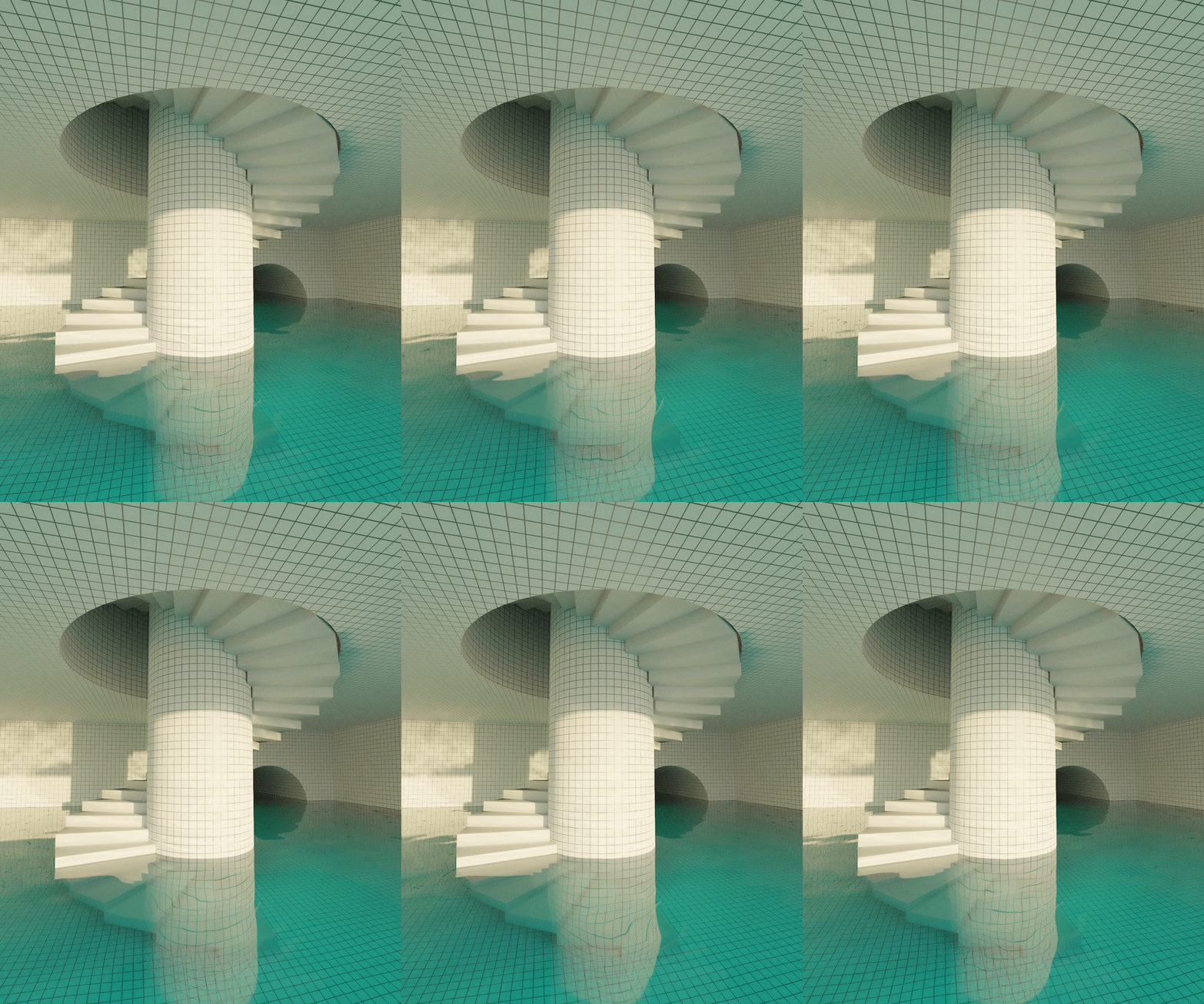
Sublevel 16 unfolds as an endless maze of submerged architectural spaces, similar to Level 37. Corridors and chambers lie partially flooded beneath a calm, turquoise surface. The environment feels like the inside of a massive aquatic structure. Its shape is precise and deliberate, but it stretches far beyond any reasonable scale. Water fills every open area to a uniform depth. It remains glassy and still, reflecting the structure above with near-perfect clarity. Tall columns rise from the tiled floor, flaring out as they meet the ceiling. They have smooth, pale surfaces, with their bases disappearing into the water below. The columns repeat endlessly, arranged in neat rows that define long passages and vast, open halls. Between them, the space branches subtly. It offers multiple paths that curve gently away from one another before fading into further columns and flooded corridors.
The floor beneath the water is tiled in calm tones, though the grid is distorted by refraction. Moving through the water creates slow, deliberate ripples that spread and fade without resistance. Sound is heavily muted. Footsteps entering the water produce dull, hollow echoes that feel distant even when close, as if the space absorbs sound rather than carries it. Staircases descend into the flooded sections at regular intervals. Their steps glow from beneath with soft green lighting that shines steadily through the water, marking transitions between levels that never feel separate. Each staircase leads into more submerged halls, more columns, and more branching paths. No staircase leads entirely out of the water. Lighting throughout the sublevel is soft and indirect.
A pale glow comes from unseen sources above, filtering down through the water and casting wavering reflections across walls and ceilings. Shadows are blurred and unstable, constantly shifting with even the slightest movement in the water. Despite the openness of the space, visibility is limited by distance and repetition, not darkness. The water itself is clear but appears depthless. Looking down provides no sense of how far the floor truly extends. Looking ahead makes reflections overlap with reality until the divide between surface and structure becomes difficult to see. The maze feels layered both vertically and horizontally, yet every path ultimately leads back to the same flooded expanse. There are no currents or signs of flow or drainage. The water remains perfectly level throughout the maze, regardless of gravity or architecture.
The temperature is consistent, calm but not uncomfortable, reinforcing the impression of a controlled, artificial environment. As the maze goes on, the repetition of columns, stairs, and water dulls any sense of progress. Distances stretch subtly. Spaces that seem close take longer to reach than expected. The sublevel neither resists nor rewards movement. This space is defined by suspension rather than motion. The infinite maze extends endlessly beneath still water and soft light. It preserves a state of quiet submersion where every path leads deeper into the same calm, reflective shapes, and nothing ever fully rises to the surface.
The water washes away my soul.
Sublevel 17
Entry 18
Sublevel 17
Sublevel 17 appears as an endless interior maze of narrow, identical corridors. Each corridor stretches forward into a soft blur that never completely resolves. The hallways are long and straight, bordered by pale walls that unevenly reflect light, creating a washed-out, indistinct quality. The farther the corridor goes, the less defined it becomes, as if distance is being gently erased. Overhead lights are placed at regular intervals. Each one emits a muted, circular glow that pools on the ceiling and fades along the walls. The fixtures repeat endlessly, spaced enough to suggest order but close enough to eliminate any sense of progression. No matter how long you walk, the lighting ahead looks just like it did when you started.
Doors line both sides of the corridor, evenly spaced and identical in shape. Some appear closed, and others are slightly ajar, but none reveal anything distinct beyond their frames. Peeking inside offers only darkness or another corridor just like this one. The doors feel more like punctuation marks than entrances, breaking the walls without providing alternatives. The floor is covered in a dull, neutral carpet, its texture softened by wear. Footsteps sink into it quietly, making little sound and leaving no trace. The air is still and slightly warm, carrying no noticeable scent. Sounds behave oddly here. Movement seems too quiet, as if the corridor absorbs noise before it can fully exist. Perspective becomes unreliable the longer you look at the maze.
The corridor ahead narrows, then widens, without actually changing shape. The walls feel closer than they should and then distant again. Sometimes, a section of the hallway seems familiar, not because it is the same but because it is indistinguishable from every previous section. Intersections are rare, but when they do appear, they lead into identical corridors that perfectly mirror each other. Choosing a direction feels random, as every path has the same length, lighting, and silent continuation. Turning back rarely brings reassurance. The corridor behind looks no more recognisable than the one ahead. There are no windows, clocks, or signs of time or location. The ceiling stays at a constant height, pressing down just enough to be felt. The walls never show damage or decay.
Everything is intact, maintained, and endlessly repeated. This sublevel does not threaten or confront. It simply extends. The infinite maze continues through uniformity and subtle distortion, making each step forward feel both necessary and pointless, and ensuring that every corridor, no matter how far it goes, always leads into the same softly lit distance.
I felt something scratch me; it was the worst pain I've ever felt.
Sublevel 18
Entry 19
Sublevel 18
Sublevel 18 looks like an endless vertical maze of stairwells and narrow landings, repeating for what seems like forever in dim, unfinished interiors. The design is basic and bare, made of raw concrete walls and sharp angles that feel temporary, as if the building was never meant to be finished. Every surface shows faint stains and discolourations, marks left behind with no apparent reason, and never moves into decay. Staircases rise steeply into darkness. Their steps are even and worn smooth, even though they show no signs of age. The stairs are tightly enclosed on both sides, making the space feel compressed and drawing the eye upward. Light fades quickly as the staircase climbs, swallowed by shadow long before reaching the top. Going down offers no more clarity.
The darkness below feels just as deep and unresolved. Landings appear at regular intervals, leading into short corridors or more stairwells that turn sharply, either upward or downward. These junctions are small and cramped, with low ceilings and poorly lit corners. Doorways occasionally open off the landings, but they lead to more staircases, offset at different angles, as if the maze had been folded vertically rather than spreading out. The lighting is minimal and inconsistent. Weak light spills from unseen sources, catching the edges of walls and the front of steps before disappearing suddenly. Shadows pool heavily beneath stair treads and along ceiling seams, hiding depth and making it hard to judge distance. The light never gets brighter, no matter how high you climb, and darkness never entirely turns into black.
Everything stays half-visible and unfinished. The air is stale and heavy, carrying a faint scent of concrete and dust. Sound acts strangely in the confined space. Footsteps echo both upward and downward at the same time, overlapping and returning distorted, as if the stairwell can't decide where sound should go. Stopping creates a thick silence that feels contained instead of empty. As you move through the maze, repetition becomes inevitable. The same landing shows up again, with only slight differences in wall stains or angles. The same staircase feels familiar but remains unrecognisable. Direction loses its meaning. Climbing doesn’t feel like progress, and going down doesn’t feel like retreat. The structure allows movement but no destination. There are no windows or outside references.
The stairwells exist in isolation, caught in their internal logic. Each turn leads to another climb, another descent, and another dimly lit junction that loops back into the same vertical path. This sublevel doesn’t overwhelm solely by scale; it does so through persistence. It is a maze made entirely of transitions, denying any sense of arrival. The staircases continue endlessly, ensuring that every step leads to a landing that never actually takes you anywhere else.
I can't stop, not after I have come so far.
Sublevel 19
Entry 20
Sublevel 19
Sublevel 19 looks like an endless maze of quiet, softly furnished rooms that remind one of children's reading areas or community lounges. Each space opens into several others through wide doorways, creating a branching layout that feels intentionally gentle. The rooms are small, but their uniform design stretches forever, repeating the same setup without any clear boundaries. The floors are covered in soft grey carpet, thick enough to muffle footsteps almost entirely. The walls are painted in warm, neutral colours and decorated simply with framed pictures and shelves filled with neatly organised books. The shelves are always stocked, yet the books remain untouched, their spines unbent and their titles hard to recall once looked away from. In some rooms, small desks or low tables sit close to the walls, placed as if they have been recently used but never disturbed.
Prominent plush figures frequently dot the maze, especially oversized stuffed animals propped up against the walls. They are clean and intact, their fabric soft and slightly worn, showing signs of frequent handling in the past. Their expressions are unchanging. They sit patiently in corners or next to shelves, turned toward the centre of the room, seemingly meant to observe rather than engage. No room is without one. Seating is grouped in small clusters. Soft chairs, couches, and ottomans form cozy conversational areas that seem inviting but unfinished. Sitting down offers no sense of relaxation. The furniture rarely fits the room the same way twice; sometimes it’s pushed closely together, other times it’s farther apart, but it’s always arranged with careful symmetry.
From each seating area, multiple exits lead to identical spaces. The lighting is warm and consistent, provided by recessed ceiling lights that don’t flicker or dim. The light casts shallow shadows under the furniture but keeps the corners clearly visible. Some rooms have windows, but they offer no view beyond a vague brightness that reveals neither sky nor buildings. Looking through them gives no sense of direction. The air is still and slightly warm, carrying a faint scent of fabric, paper, and cleaned carpet. Sounds are heavily muted. Even small movements seem distant, as if the rooms are cushioned against noise. Silence here is not empty; it feels muffled, contained within the walls. As the maze continues, the repetition becomes clearer.
The same bookshelf reappears with the same arrangement of books. The exact plush figure remains in place. Rooms feel familiar without being easily recognised as places already visited. Efforts to trace a path only lead through spaces that seem right but are indistinct. This sublevel does not rely on confusion or obstruction. It creates disorientation through comfort and consistency. The infinite maze maintains an atmosphere of a safe, inviting space while offering no sense of direction or exit, extending endlessly through quiet rooms meant for children who never arrive and moments that never advance.
I'm so scared.
Sublevel 20
Entry 21
Sublevel 20
Sublevel 20 appears as a massive, unfinished interior that looks like an industrial shed, completely suspended in a dark void. The space is wide open, with rough, pale walls that rise up and then vanish into darkness. The floor is covered in thin, worn carpet that feels out of place against the otherwise basic design. The carpet stretches endlessly, without any marks or seams, floating above an abyss that absorbs all light beyond the immediate area. The walls are bare and uneven, showing faint stains and discolouration that hint at age but not decay.
There are doorways cut into the structure at irregular intervals, rectangular openings leading into deeper darkness. Some look shallow, while others seem to go farther than expected, but none allow visibility beyond their thresholds. The ceiling, if it exists, is never clearly visible. Light fades upward into black, making it seem like the space continues vertically without limit. Illumination is minimal and localized, as if it follows me rather than coming from a fixed source. Only a small part of the floor and nearby walls are visible at any time. Everything beyond that quickly fades into nothing. The abyss around the structure is complete, swallowing depth, distance, and sound. There is no echo. Movement makes only the slightest noise, quickl
I’m going to stop pretending I can document this properly. There’s no point in keeping any structure or tone. I keep writing as if it matters, as if someone will find it or it will be helpful to someone, but I know it won’t. No one is coming here. No one is reading this. The level doesn’t want to be understood, and I’m not sure it even notices my effort. I can’t stop moving. I can’t.
I sent out an email back in Sublevel 3. I don't think it left this place, and if it did, I'm sorry for cutting it off here; you must be really confused. I had a vision, or maybe it was a thought that felt alien, and it made one thing clear. If I stop walking, if I sit down, if I hesitate for too long, something will happen to me. Not quickly. Not cleanly. I don’t know what it is, and I don’t want to know. Just knowing is enough to keep my legs shaking and moving forward.
The shed doesn’t change. The doors don’t lead anywhere new. The darkness doesn’t lessen. But as long as I keep walking, nothing reaches out. That’s all I have: forward motion and the hope that whatever waits knows only how to hurt things that stay still. I’m done trying to explain this place. I’m just going to keep walking.
Goodbye.
- Julian Harold Charles
Decrypted Audio from Sublevel 3
Case File: Sublevel 3 Broadcast Incident
The sublevel looked like other retail spaces I had seen before. The aisles were wide, the flooring shiny, and fluorescent lights hung in long, buzzing rows. The shelving units stood tall and straight, but they were completely empty. There wasn't any packaging, no labels, and no price tags. It was just bare metal and smooth surfaces, repeating endlessly as the aisles branched off and came back together. I had been wandering through this space for some time when I first noticed the sound.
Initially, I thought it was another strange noise. A faint clicking, irregular and almost rhythmic. It didn’t echo like footsteps do. It felt localized and solid. Following the sound led me to a service corridor that shouldn’t have been there, hidden between two shelving units that were supposed to be continuous. At the end of the corridor was a small office. Inside, to my surprise, sat a computer. It was old, with a beige case and physical buttons. The monitor was thick enough to seem outdated, even by earlier standards. There were no cables connecting it to the walls, yet it was on. The screen showed a blank desktop, with no wallpaper or icons, except for a single audio control panel that was already open.
That should not have been possible.
I approached it carefully. The air in the room felt heavier, not warmer or colder, just denser, as if the pressure had increased slightly. The fluorescent lights outside the office appeared dimmer from within, their hum fading into something dull and far away. The computer responded right away when I touched it. There was no boot-up sequence, no delay. The audio panel reacted as if it had been waiting for me. That was when I realized the system connected to the store’s announcement speakers. I hadn’t seen them before, but once I did, they were hard to miss. They were mounted high on the walls between the aisles, identical and silent.
I don’t know why I decided to record a message. There was no plan and no intention to communicate. The thought didn’t feel like a decision. It came already formed and justified, like something I had to do before moving on.
I pressed the button. The microphone crackled softly. The sound echoed faintly through the office speakers and then spread out into the store. The delay felt wrong, too slow, as if the space had to think before allowing the sound to exist. I tried to speak. No words came out. Not because I couldn’t talk, but the moment I tried, something shifted. I felt pressure behind my eyes and in my chest, as if I were being pulled forward from within. Not physically, but internally, as if whatever makes me who I am was stretching toward the microphone. When sound finally came through, I realised it wasn’t following my mouth. The voice over the speakers was mine; it was trying to speak what I was thinking, but it lagged behind my thoughts, turning into an almost demonic screech followed by a strange lullaby.
Recovered Personal Documentation
Case File: The Blinding Light Incident
I did not walk into the next sublevel. There was no corridor, no doorway, and no gradual shift in layout. One moment, I stood between two empty walls, Then everything turned to light. Not brightness. Not illumination. Light in a way that replaced everything else.
It came without direction or source. There was no flash or warning glare. The space itself seemed to flip, as if darkness had been violently removed. For a brief time I cannot measure, I was engulfed by pure white intensity, uniform and absolute. It felt like my skin was melting. Not burning, not tearing. Dissolving. As if the boundary between my body and the environment no longer existed. I felt an overwhelming sensation that my surface was turning fluid, that my outline was vanishing, that whatever separated me from the outside was being smoothed away layer by layer. There was no pain in the usual way. Pain involves nerves, signals, and sequences. This feeling was more immediate. It was like being told, all at once, that my physical form was negotiable.
I tried to close my eyes. It didn’t help. The light wasn’t entering my sight. It was my sight.
Then the visions began.
They did not come one after another; they overlapped. Shapes unfolded into other shapes without transitioning. Impossible geometries rotated through each other, not in three dimensions, but in something close to that. Angles bent inward. Lines crossed where space should not allow them to. Structures built themselves while also collapsing, repeating the process endlessly without contradiction. I saw corridors made of triangles that folded into spheres. Staircases that climbed across flat planes and somehow ended up beneath themselves. Rooms with all corners, no walls, no floors, yet fully closed in.
Patterns repeated at scales that made no sense. A shape the size of a building would suddenly appear as a detail within itself. The same structure nested endlessly, recursion without depth. I could not tell if I was moving through these forms or if they were moving through me. Some of the geometry noticed me. Not in a conscious way. More like a function adjusting for an unexpected variable. Lines realigned. Shapes hesitated. One configuration collapsed too soon, as if my presence had disrupted an equation that never intended to include a human observer. That was when the terror truly began.
Not because of what I was seeing, but because I was certain this was not meant to be perceived from the inside. These visions were not environments; they were internal mechanisms briefly exposed. Like seeing the inside of something that was only meant to be experienced from the outside. The light intensified again. For a moment, I believed I was gone. Not dying. Gone. Converted into something else or spread too thin to reassemble.
Then it stopped. It only took one blink before I was on the floor of a new sublevel.
Recovered Poem
Recovered Journal Extract — Author Unknown
(The following text appears handwritten, though the ink shows no sign of smearing or age. Several lines repeat faintly beneath the original, as if written more than once in the same place.) At the precipice of the void’s chasm I learned that depth has opinions. The floor withdrew its consent. The dark leaned forward and called it patience. Angels began correcting my thoughts. Rooms nested inside mistakes. Stairs returned me to sentences. I never finished writing. I prayed once. That was enough. God looked at me and chose architecture instead. Silence, measured perfectly. Punishment without heat. Now the maze speaks in corners. My name no longer fits in my head. I am being folded into something useful. If I stop, it notices. If I move, it smiles. The chasm speaks more kindly than heaven ever did.
Sources
Adapted from the original article, under CC BY-SA 3.0.