Place
Level 89
Mountainous Madness
Level 89, also labelled as Level TH 7, is the 90th level of the Backrooms.
๑.] Indoor Setting
Level 89, known as "Mountainous Madness" or "Furniture Madness", appears as an aggregation of edifices whose spaces feature bizarrely arranged furniture. The building's layout suggests academic institutions above all else. Places include schools, examination halls, administrative offices, lecture buildings, and other various sites. However, these architectural archetypes do not exist independently, as countless nonsensical areas of pillars and walls emerge through the overlapped and interlocked edifices. Otherwise, they leave a large, void-filled building to the point that the structure is visibly incapable of sustaining its own weight.
While not much can be said about these buildings, what distinguishes Level 89 most viscerally is the presence of desks and chairs in every single corner, whereas other kinds of furniture only appear sporadically and are initially present in the building. One could describe an entire place as oddly overembellished, completely neglecting any purpose the place was to serve. Its presence also manifests as extremely dense in the amount of furniture. Most accounts within report similar disturbing and uneasy sensations upon their entry from this omnipresence. Let alone that most of the level is surrounded by darkness, as the building's interior light source and electricity system are mostly damaged, leaving only small lighting from an unreliable source.
Upon observing furniture arrangement, multiple rooms resemble classrooms, meeting halls, or waiting rooms. However, through witnesses, the way the furniture arranged in most case deliberately seem as sort of abnormality artwork as if the level trying to represent itself; these oddness's ranged from the entire ground carpeted with desks and chairs, all pieces of furniture hang upside down from the ceiling with thin, fraying cords, to the same objects appear stacked themselves into series of tall tower like architectural mockeries similar to the creation of a house of deck card or pyramid structure.
The desks and chairs themselves vary in features and appearance, and usually appear internally uniform within each localized region. Close inspections reveal that they are from low-quality material comparable to the poor-grade furniture. Most exhibit severe deterioration remaining here longer than the manufacturing period from the Frontrooms themselves. Furthermore, additional studies claim that several furniture supports were initially poorly assembled, even prior to deterioration. Therefore, it is highly discouraged to use this furniture, nor is there an instance of anyone bringing them to utilize, aside from researching.
๒.] Outdoor Setting
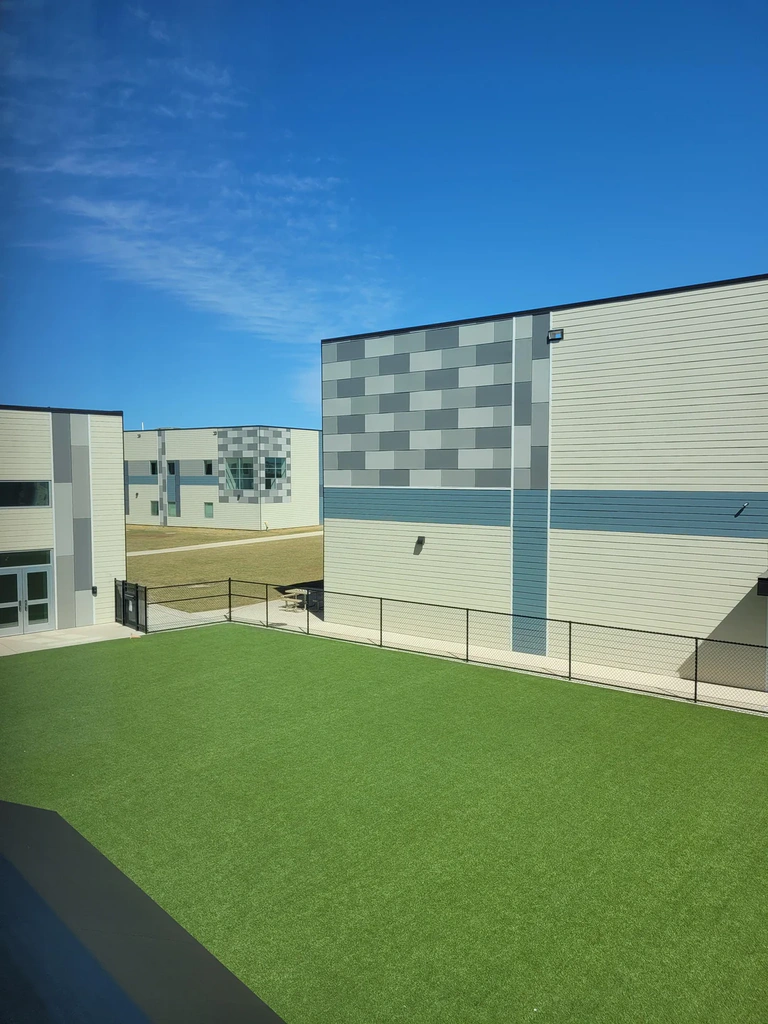
Although avalanches of furniture frequently block access points of many buildings, exterior traversal is considered easy through windows or an open balcony in some hallways. The outside environment appears no less disordered; a landscape consists of sprawling buildings haphazardly placed, inadvertently resulting in enclosed courtyards, narrow alleys, and irregular passages. Through exploration conducted on the safe ground, the surface is intermittently paved with small, winding asphalt roads and typical concrete sidewalks on the overgrown grassland. The outdoor shows no active maintenance on an excellent scale. Vast portions of the landscape are made entirely inaccessible by the sheer density of objects; hence, comprehensive mapping of the topography remains strongly infeasible.
The atmosphere appears gloomy and may be covered in complete darkness, potentially allowing various dangers to linger. Accounts describe the sky as perpetually occluded by thick, crimson-hued cloud cover alongside its horizon, painted in absolute blackness, occasionally tinged with the same deep red. Although it seems an eternal nighttime, lateral information from the further area confirms that the level does hold its celestial object and regular day–night cycle, hinting that both the cloud and the entire air itself may completely refract incoming light back.
The presence of furniture in the exterior occupies far greater, or rather, the outdoor influence over the interior itself: the majority of open spaces are full of chairs and desks fused into a monolithic heap, making outdoor traversing not even considered an option. These piles may fill entire courtyards and alleyways to the point that they surpass the roofs, and masses breach interior spaces through windows and doorways, exacerbating the already chaotic arrangement within.
Should one travel deep enough beyond the dense architectural clusters, they will encounter distant silhouettes resembling multiple rolling hills and mountain ranges barely visible. Disturbingly, they are not natural terrain but the same piles of furniture, equivalent in size to natural landforms. The same also applies to the plains; the supposedly grasslands are instead the titanic mass of desks and chairs. One could describe the entire terrain of the level as replaced by an endless stratum of institutional furniture. There is absolutely no scientific framework behind the origin or sustained existence of this quantity that goes beyond any manufacturing capacity known to the Frontrooms.
Not only do the hazards of the outdoors intensify, so do its abnormalities: one may come across furniture configurations that far exceed structural plausibility. These instances ranged from desks and chairs stacked up against one another in staggering height without visible means of support, coalesced into giant constructs of indeterminate purpose, to disturbingly mimicking arboreal natures by compressing desks into a truck with chair-like branches. Additionally, any once existing large vegetations and biome terrain here has likely eradicated by the influx of furniture — possibly crushed altogether. Rarely, the only ones alive are usually in proximity to structures that are largely devoid of furnishings. Nevertheless, tables and chairs are frequently hung on those branches or wedged among foliage that never seem like incidental entanglement.
Several inaccessible high buildings have been the focus of repeated anomalous reports. Travelers saw desks and chairs being thrown from the windows at regular intervals, hurled outward into the heaps below. The resulting impacts can create resonant, percussive thuds. As a case in point, something behind this window appears to materialize a never-ending amount of material, leading to the idea that these windows lead to another dimension of continuously sourced furniture.
It is unknown who is behind the cause of throwing objects aimlessly. The concept of a sentient life responsible for this act is unlikely due to the uncannily consistent timing and force. The motion is mechanical, yet no machinery has ever been observed. Rather than mysteriously, there seems to be no possible answer regarding what this phenomenon could gain from doing so endlessly, as it neither alters the structure’s interior nor significantly contributes to the already immeasurable accumulation of furniture within the level. While proposals for a targeted investigation into this behavior — a proposal that suggests the investigator carefully climb up the building wall. Due to the outdoor environment, no one decided to conduct further.
Furthermore, individuals describe the atmosphere as echoey with an unsettling hum from an unidentified source, especially outdoors. The same atmospheric properties that cause darkness may also reflect sound unnaturally, causing even minor noises to propagate. As a result, the level is intensely reverberant, despite the open spaces environment and cluttered surroundings that would ordinarily dampen sound. Moreover, wanderers say that the extremely mountainous pile of furniture created a sound similar to the crushing of metal objects within an industrial shredder from afar.
๓.] Disappearances
The main danger of Level 89 may not be the environmental hazards, but from an elusive presence that manifests primarily outdoors. This presence is most likely to be responsible for the disappearances recorded within the level. Through countless testimonies from the survivors witnessing other individuals disappearing, survivors detail that something grabbed the victim and then pulled them into the pile within seconds with extreme force, presumably to death. No confirmed victim has ever survived after such an event.
Attempting to reconstruct the appearance of the entity alone has proven futile, as most involved fail to register the disappearance until the incident unfolds. Those who do witness provide inconsistent explanations due to the lack of clear visibility and atmospheric distortion in the vicinity. Some accounts describe a physical appendage emerging briefly from within the furniture mass: on one hand, a limb-like structure grasping the victim. Disturbingly, these appendages are frequently likened to the legs or supports of chairs and desks. On the other, one simply reports no visible contact with the victim at all as if being dragged by an unseen force.
Furthermore, auditory anomalies further added to the threat. Wanderers occasionally hear echoes of human-like voices emanating from within the furniture piles, as it was later classified that these sounds are associated with the same unknown presence. Individuals claim that soon after fully exposing themselves to the outdoors, they began to hear nonsensical voices that don't belong to any language, while their tone seems hostile or agitated and sometimes punctuated by sharp impacts from throwing or hitting desks and chairs. Interestingly, the vocalisations appear to be one-sided arguments at a third party.
Despite this, many researchers believe the mimicry holds a purpose of luring any exposed human; in certain cases, the sound seems unnervingly persuasive. Most unaware travelers will assume that there is another human nearby, hence leading them to investigate.
๔.] Madness
As paradoxical as the topic was, observing their collective behavior, the way furniture inside the level behaves seems to exhibit sensations, which many would describe as hostility and madness, or otherwise cognition without consciousness. Observers repeatedly report that the furniture conveys an impression of intent and how the environment never appears unchanged.
Obviously, every piece of furniture is a solid object and will always behave like a solid object; however, the vast piles exhibit properties more characteristic of a viscous fluid. In many cases, the furniture floods into buildings that overrule their architectural constraints. Examples include entire rooms that are connected to the outdoors, filled with desks and chairs compacted to the ceiling, while in extreme cases, entire structures are internally saturated. According to physical laws, such extreme mass should collapse, or it cannot easily enter through the building's small openings.
Although there is almost no damage done to the exterior part of the building, it strangely displays internal damage, including cracks and fractures. Damages inside the building originate from forceful internal displacement rather than gravitational overload, wherein one can notice broken furniture nearby, which is likely the cause. What initiates this movement remains unknown, especially the relocation of such large masses of objects, as the buildings themselves show there is no autonomous motion, and environmental factors such as wind or seismic activity. This has led to recurring speculation that the furnishings themselves constitute a form of distributed life via an unknown means. Others argue that an external force animates them, manipulating inert matter. Neither hypothesis has been substantiated.
Moreover, researchers faced even more headaches of auditory reported cases, which involved hearing the sound of large numbers of objects dragging against the floor simultaneously within the same building, as though dozens of people were rearranging furniture at once. Then, upon investigation, the presumably area shows no evidence of cause from this sudden movement except the already displaced furniture. Crucially, through extensive research and study involving the extraction of furniture that many are suspected to contain anomalous property, or once moved, only return to the same conclusion that these samples feature no trace of autonomy or anomalous response.
While collecting a sample of furniture, it was also noticed that chairs and desks that are subjected to crushing beneath a pile of objects undergo an anomalous transformation. Erosion usually affects metal legs and frames, creating more jagged and razor-sharp edges. The deeper they burrowed from atop, the more severe and unnatural the deterioration seemed to become. They could present as a physical danger from puncture wounds to those who attempt to traverse or climb the piles. The mechanism behind this erosion remains speculative, with most suggestions being that it is some form of aging whereby the level degrades its own matter to prevent cloning furniture from flooding the entire level.
๕.] Hostility
Among the most concerning aspects of Level 89 is the frequency with which human remains are encountered, often lying inside the interior building despite documentation indicating that the majority of disappearances occur outdoors. The corpses themselves display little to no visible decomposition, always in a state of recent death. Autopsies, where feasible, reveal the cause of death from extensive blunt-force trauma and deep puncture wounds with violent impact from moving desks and chairs. There is no single fatal injury common to all cases; instead, the bodies appear to have been subjected to overwhelming mechanical force, which witnesses horribly describe as execution enacted by the godwork of nature.
Those who have encountered these remains describe the experience as traumatic. The corpses are sometimes found forcibly arranged in postures that evoke deliberate cruelty. Their injuries appear to have been caused by a long interaction of violent intimacy where their flesh and bones may tear, and their bodies contorted into the most nightmarish positions.

Documented examples include, but are not limited to:
Importantly, there are no verified accounts of survivors witnessing such an attack in progress. Identification of the deceased is impossible due to their obliterated facial features, and dismembered bodies are beyond recognition. Moreover, personal belongings are either destroyed or absent. It is possible that these deaths occur exclusively in isolation when unobserved by other parties, although there still exist numerous wanderers who have traversed the level alone without incident. Regardless, entering the level alone is strongly discouraged, and avoidance is the best wherever possible.
More unsettlingly, paper and any writable artifacts, such as notices and posters, affixed throughout the building, show mundane announcements or historical displays originating from the Frontrooms. They contain explanatory paragraphs and illustrations that may seem disconnected from the level itself upon first glance. However, prolonged examination of both text and imagery reveals a disturbing coherence of violent depiction in the ways that ordinary objects, especially chairs and desks, have been implicated in human cruelty. One frequently cited example includes an allusion to the 6 October massacre in Thailand, in which a crowd is shown surrounding a body hanging from a tree, beaten by an assailant wielding a folded chair.
Furthermore, numerous objects consist of messages scratched directly into their surfaces, especially on wooden desks, written in sentences that most of the time humans can't comprehend. The writing alone is already erratic and uneven, which doesn't belong to human script. These messages can range from a word to multiple paragraphs. Interpretation by experts suggests its meaning varies widely, but most share a discernible negativity. They can range from confessions without authors, indictments without defendants, addressment to the reader or level itself, or our society at large.
• Metal chair legs driven entirely through the orbital sockets and oral cavity, pinning the skull atop the carpet floor.
• Limbs, organs, and sections of torsos under the desks, folded, and stuffed into confined spaces far beyond what the human body should allow.
• Head forcibly inserted into desk compartments, the cranium mutilated and cut until it fit, while filling the entire scene with blood.
• A dead body impaled against walls by multiple sharpened furniture components, suspended above the floor with blood pooling onto the floor in a grotesque imitation of display.
• Corpses discovered partially threaded through apertures in chairs where their openings are structurally too small to even consider putting a body through.
• The victim's back carried a single towering stack of countless chairs acute to the point their spines pulverized and exposed, and their skeletal structures protruded.
๖.] Further Area
If one chooses to navigate further into the level — passing through buildings while avoiding the outdoors and risky areas — eventually the environment will slowly change. Long-range expeditions reported that level’s hostility appears to attenuate; the number of furniture becomes sparser, and the sky itself sheds its darkness for displays of clear blue atmosphere by day and a star-filled sky by night. One detail of this area is that it is a tranquil place for an escape from danger, leading to an inevitable question about the level’s topography inconsistency.
As the distance goes on, the omnipresent sea of desks and chairs continues to thin, both outdoors and within structures. Furniture no longer appears as monumental piles here and instead sporadically, haphazardly scattered around — the decrease in material congestion also means a complete absence of hostile presence. Oddly, as visibility improves, any expectation of restored natural landscapes is subverted instead, where an entire terrain now becomes an undisturbed expanse of concrete, expanding in all directions. Buildings also become increasingly rare, isolated from one another by vast distances, and eventually cease altogether.
Photographic evidence recovered from an exploration specialist — one of the few individuals to have reached the furthest boundary of the level — indicated that from one point onward, the number of desks and chairs begins to stabilize at a fixed point, and the environment remains unchanged anymore except for the never-ending number of chairs and desks across the concrete plain. From his words, it is unlikely that there will be any new presence of structure or areas. For those who reach this faraway land, it is strongly advised to seek an exit as soon as one becomes available. While exits in this region are not abundant, they may materialize with a lower chance than within the level’s center.
๗.๑.] Entrances
The Senbon Torii gate in Level 666 may eventually lead to this level.
An arcade game found in Level 25 may transport wanderers to this level.
Turning equipment off inside of radio stations in Level 151 has a chance to lead here.
Entering any basement within Level 52 will lead here.
Noclipping through furniture, such as tables or chairs in the restaurant of Level 88 will lead here.
๗.๒.] Exits
"I once met an introspective man here. Apparently, he was very quiet and composed when I accidentally looked at him. He was the type of man who understood himself far too well that he could look through every one of his organs because his self-clarity already brought all the internal anatomy surrounding him. And when I say he could see his organs, I meant literally. Eight chairs in a circle, with each of them. I'm not sure if he can remember giving me a trauma, but his body definitely disremember him."
—Witness to no one’s crime scene
๘.] The Sea
This place, I have no idea what to call or describe. I tried to name it so my mind no longer has to refer to it as a nightmare as a whole, but it just feels like any name would fail it. Let me tell you, a bad place always leads you to the bad place, even if you don't think it is — the hallway to hell took me to yet another maddening hell, and those struggles will never be over. It was really draining on me to travel through countless places, let alone this place of rooms and hallways with wooden tables and chairs. The hardship does not give itself away all at once and slaps my face with words that I should be thankful for a virtue from this endurance.

Through the sensation, those chairs and tables in sight seem to grow complicated after traveling through so many unforgiving locations and bad situations. And when I rested, I would sit in the dark corner and lean against the wall. Then, those ugly wooden chairs would stare and call me to rest on them. They wore me down more than any left-open thought in my head could have. The way those stacked chairs and desks on top of each other show a pile of pressure that I could feel as heavy as a weight stuck at the back of my head.

These buildings are so cruel. I always run into dead ends when I thought I was about to make some progress. My hope faded too little, or it was already gone from all the previous hardships. Outside the wall, I always see the vast piles of desks and chairs trembling in complete darkness. I would often turn around and ask those chairs why we are still here, then they would breathe and watch me back silently. These chairs keep blocking the middle of the dark, long hallway I was going to, and the air, too, feels so loud, and I would punch the air back at those stacked chairs, and it would fall like dominoes.
I often asked myself and those tables and chairs, what this place was meant to represent. I doubt anyone truly knows. Maybe our lives? I suppose it tries to represent negatively things about the place that measures worth by numbers and paper. I assumed it tries to understand our bad experience, where everyone would later think about this place's genuine intention, just like how much furniture here has already neglected everything that matters. Throughout the little mission of mine, I always heard echoes of distant shouting from nowhere. The voice seems to vent about something and feels like it's on the verge of a breakdown, perhaps the emptiness of this place itself. It reminded me of moments when I had seen people breaking down in school with their years of pressure after they couldn't handle all the exhaustion from their lives.

I myself also carry my own bad experience from such a place. I often questioned this system, whether there is a flaw or not. But the way it is so difficult that my mind becomes as tangled as those piles of tables and chairs in those mountains, vast as any landscape. I understand that this changing life test is difficult, just as life is difficult. Life is always meant to be difficult, but I still doubt why it is so unforgiving. The idea of one paper that decides everyone's entire future level just never sits right with me. Now that I haven't reached the outside world for many years, I still hope that the world has gone through some changes. I think I may understand the madness behind this place.
Eventually, after wandering across miles of land, I started to notice that this madness of furniture grew sparse, revealing the concrete floor underneath that endlessly stretched toward the horizon. Nowhere have I seen those numerous mountains of furniture backs earlier, as chairs start to become more distant from one another. I, in time, walked out of the building as none of them appeared from this point on, so I continued to traverse. For a little while, it seemed like I had escaped, but I know that this expansion has yet come to an end; my mind stops interpreting settings around as if my consciousness for a moment switches into both of my legs that continue to walk aimlessly.

Then things change, I can smell the scent of salt and strong wind in the distance. There, the floor softly transitioned into the sand that led me toward the sea and the horizon of almost the end of the afternoon. I stop walking immediately to see the beautiful sun above, which I haven't seen in many years, about to set behind the horizon of the sea. My leg immediately feels numb, as well as my mind, which may have come to the acceptance that everything has come to an end here. The place I described is finally a spot that delivers one a calm respite from the long exhaustion. A small reward, I suppose.
I quietly realized that this place came with no exit, only an endless shoreline, while the concrete landscape was still expanding behind me. My backpack had grown light, and with that lightness came dread but I knew as much that my mind already saw it coming miles away; it mumbled to myself that if it is like that, then that is how it is, there is no reason for me to worry anymore. I had no food left, and my body trembled with exhaustion, lying on the sand and facing toward the sea. My mind finally got to think, so it asked a question I had avoided for a while: Does hardship often in time guarantee fulfillment? Or does it sometimes lead to emptiness?

In another life, I thought about myself otherwise living a successful life, ultimately got into a respectable career, but what if I realize that I don't like it, and I have to be stuck with it forever? I may still be able to do something I love, but I will be left with little time that I would never feel is enough, like myself currently, standing before the sea that I felt as though I had given everything, only get this tranquillity without genuine joy. I had always dreamed of exploration across various places, but then life took a turn and took me into another dimension.
I know, it's always a cruel space, but I'm glad they are also honest to me ever since that mono-yellow wallpaper. I navigated alone for most of the time, while anyone that I got to band with through coming across or accidentally getting to know, mostly disappeared and died. This part of nature makes me want to travel alone so I won't see anyone die again, and I guess all of those happenings seem to teach me something deep in my heart. Honestly, I'm never afraid or concern to the thought of my life coming to an end anytime soon or now — because at least I did what I loved here. Even when it led nowhere, I'm happy that it's the direction I choose and I'm glad that some mistakes happened.
There, I stood before the sea and remembered a story of someone who accepted themselves fully even when the world would not, before descending into the sea. I think it is a reference to a novel I have read before I ended up here. I guess this is how everything ends, and was it worth it? I think the little hesitated part of my mind asked but I humorously replied before letting everything go. I think so — after all, what can I do right now? Slowly, painfully, starving and dying here on the beach of hard sand surface? No, thanks. I would rather rest peacefully in this body of calm water in the beautiful sunset and these starry nights of vivid stars.
I stepped into the cold water and, in time, soaked in the sea. My feet numbed as soft sand slipped beneath them. The waves were peaceful as like they understood my purpose, and for an instant, I felt like it was the first time nature turned open to us.
I noticed that the sand I strolled on seemed to cease going down into the water after half of my body was submerged and I began to feel as though I would soon be hovering through the sea. The wave is still as calm as I walk past into a pathway for a long distance to make sure of my mind. I smile to myself when I know that nature seems like it wants me to continue this little journey of mine. It's strange that our life always gives us the chance, even if it is the least expected, even the opportunity that you want is already gone and never comes back. But whatever the case may be, whatever I will go to another hell, I will accept it even if I have to meet my end, or if this sea expands forever. And here I walk and walk through half-body, soaking in the water of the sea.
Though uncertain, I think I found something in the distance.

Sources
Adapted from the original article, under CC BY-SA 3.0.