Place
Level 64
Ecological Miasma
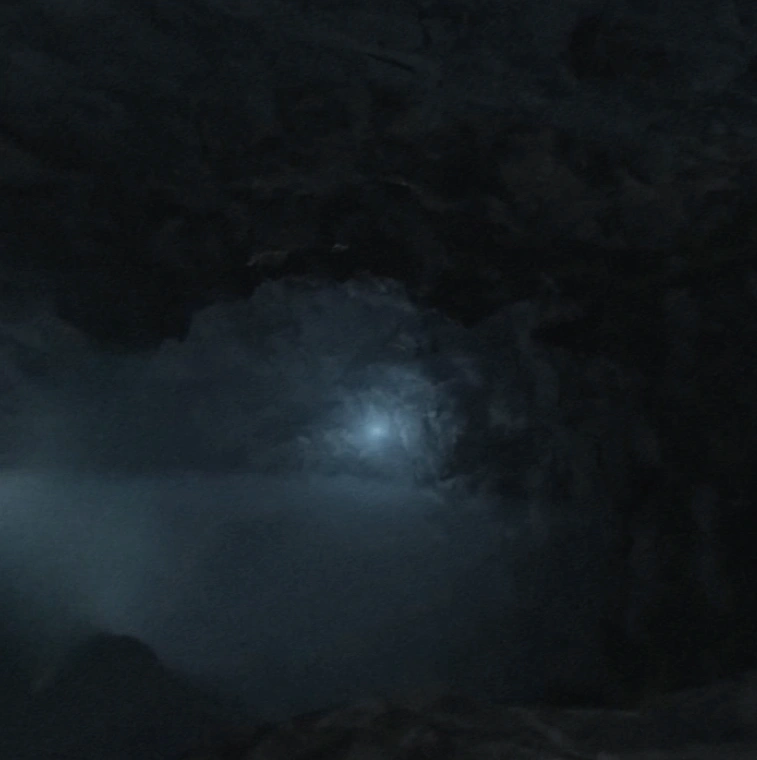
Level 64 is a sprawling subterranean network of oversized chambers, unusually high ceilings, and contaminated lakes of water. Although the cave system is shrouded in a bioluminescent purple glow, visibility remains limited. The light fails to carry into wider chambers, and instead disperses into a weak haze that blurs distant features. This haze can give the false impression of open space, hiding drop-offs and shoreline edges until wanderers are within a few metres.
The expansive structure causes extreme reverberation, allowing low-volume sounds to travel across long distances and persist as overlapping echoes. Repeated exposure has been associated with severe tinnitus, fatigue, and in rarer instances, permanent hearing loss; it's advised that wanderers minimize verbal communication, secure loose equipment, and avoid using auditory cues as a method of navigation.
Level 64 is the first documented instance of Level 630 infecting another level. Available evidence shows that a high-volume influx of Nuclear Infection breached into Level 64, causing an environmental degradation that rapidly accelerated. The level was discovered and documented only after ecological collapse, so any reliable information about its pre-infection period is not available. There have been attempts to examine the rock sedimentation and overall environment to learn what the level originally looked like, but the sheer danger of Level 64 has rendered it almost impossible to create long-term studies.
Due to the presence of Nuclear Infection, the air quality is extremely toxic, producing harmful fumes that become trapped by the cavern's interior. These fumes contain a microorganism known as a "verdbear," a type of airborne bacterium capable of surviving in environments affected by Nuclear Infection. Verdbears replicate very quickly, primarily in the pulmonary tissues when fumes are inhaled, and may contribute to systemic infection in individuals already compromised by Nuclear Infection.
Despite the enclosed, subterranean layout, intermittent bursts of wind have been documented. These currents present as brief, low-intensity gales that funnel through connecting chambers, where they circulate unpredictably before dissipating. While the airflow isn’t forceful enough to hinder movement, it’s sufficient in disturbing the level’s stagnant environment by redistributing the fumes produced by Nuclear Infection into new pockets of the cave.
Entities
Despite the level's extreme hazards, entities (e.g. skin-stealers, hounds) are not absent, and they're usually encountered in irregular pockets rather than as stable populations. Most sightings are reported near known entrances and exits, suggesting recent entry from adjacent levels, and typically linger long enough to scavenge, orient themselves, or pursue easy prey before the toxic environment force them to retreat.
The Nuclear Membri
ERROR 401: UNAUTHORIZED
Reason: The following information is awaiting for approval to be published.
Colonies and Outposts
Level 64 likely had no settlements prior to its contamination; it was the final sub-100 level to be documented, and whether Level 64 was even habitable in the first place still remains ambiguous.
Efforts to establish a long-term sustainable colony within the level is physically impossible. There was, however, a temporary base used by scientists for experimenting with Nuclear Infection.
Outpost 64
A one-cup sample of Nuclear Infection was placed inside an icebox. When the container was opened, there was no ice formation nor water in the box. The sample volume had noticeably tripled its original size, and the bottom of the icebox showed localized searing.
A one-cup sample was introduced to a boiling pot, and disappeared shortly after contact. Deterioration occurred faster than anticipated, and the result is consistent with Nuclear Infection's inability to be stored in typical containers due to rapid material dissolution.
High-temperature materials do not neutralize nor hinder the substance, and later experiments reveal that verdbears actually replicate twice as fast when exposed to hot temperatures.
A one-cup sample was poured across a partition wall with similar resistance to Level 0's walls. Structural integrity declined before collapsing in less than an hour. Deterioration was observed to accelerate as the affected area expanded, suggesting that Nuclear Infection spreads exponentially.
A bucket volume dose was applied directly to a deathmoth to evaluate entity response. No behavioural adaptation was recorded; however, the entity exhibited rapid deformation. Its wings softened and "melted" into the torso, internal organs visibly bloated to abnormal sizes, and the grey body hairs withered and detached within minutes. The deathmoth died following exposure.
The deformation did not resemble the "mutated phenotype" associated with Nuclear Infection (e.g., the Nuclear Membri). This suggests transformation is not the default outcome of exposure, and may be limited to a select number of entities, or to a narrow set of conditions that were not met during the trial.
A bucket volume dose was applied over a neutralized skin-stealer to evaluate persistence of biological residue. Over approximately a week, the remains dissolved until no intact matter was observed. Unlike the death moth trial, no deformation or partial conversion was recorded. The dissolution of the body was a breakdown of inactive tissue rather than structural reshaping.
Small group of 4 scientists.
Abandoned; was active during 2020.
Main purpose was to discover and learn more about the anomalous properties of Nuclear Infection. Their experiments have been recorded, and later replicated. Future tests produced similar results, even with different variables. This was the first, and only successful experiment in Level 64.
Exits
Error 404: Page Not Found
Error fetching level data for: "Level -1000".
Reason: Unrecognized character: "...el -100..."
Perhaps you were looking for another page?
Sources
Adapted from the original article, under CC BY-SA 3.0.